
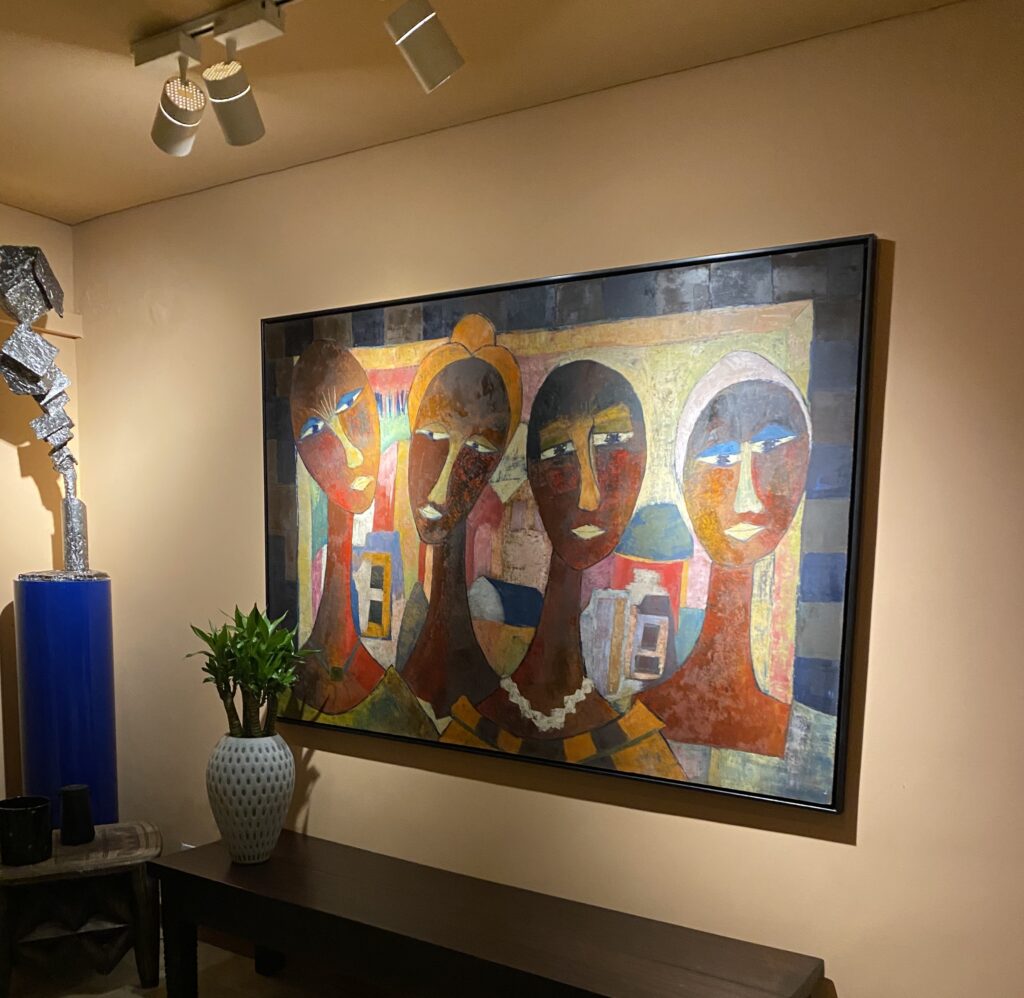
It was an eagerly awaited and much-celebrated exhibition at an iconic institution. Nigerian Modernism: Art and Independence, curated by Osei Bonsu and Bilal Akkouche, curator and assistant curator of international art at the Tate Modern in London, United Kingdom, respectively, was an incredible journey of the remarkable contributors to a significant period of art and artistic influence. Having interacted with the contemporary arts scene in Lagos since 2022, when Capital Art started its trips to Lagos with Soul Traveller Tours for ART X Lagos, the exhibition provided more of an academic and visual grounding to the art canon in Nigeria and beautifully complemented the generous sharing of information and the love of the arts our engagements with collectors, gallerists and artists in Lagos and Nigeria more broadly had fostered.
The Nigerian Modernism exhibition ended in May 2026, and we hope it travels; his post won’t do it justice, and is merely a few reflections on the exhibition in terms of the artists, the artist movements, and the sponsors and the collectors who contributed works to the exhibition. Let’s dive in.
The Artists Who Defined Nigerian Modernism
Modern art typically refers to artistic production created during the period from the 1860s to the 1970s and denotes the styles and philosophies of the art produced during that time. The term is usually associated with art in which the traditions of the past have been thrown aside in a spirit of experimentation. Modern artists experimented with new ways of seeing and with fresh ideas about the nature of materials and functions of art. The artists mentioned in the exhibition were a mix of artists whose names were very familiar, as well as those less familiar.
The early Modernists
Below are more highlights from four early Modernists; however, several others were featured, including Olowo of Ise, Jonathan Adagogo Green, and Lamidi Fakeye.
Early Nigerian Modernism: Aina Onabolu and Akinọla Laṣekan
Both Onabolu and Laṣekan were self-taught artists who were pioneers in portraiture techniques.
Onabolu’s use of portraiture challenged colonial stereotypes, representing social reality and expressing modern African perspectives. As outlined in an essay in the catalogue by Dr Bea Gassmann de Sousa, Onabolu catalogued elite Yoruba women and the painting in the exhibition Sisi Nurse (1922) is of Charlotte Olajumoke Obasa, who founded the first motor transport company in Lagos, the Anfani bus service. The painting represents Obasa in European dress but in a seated pose common in Yoruba ancestor ceneration photography.
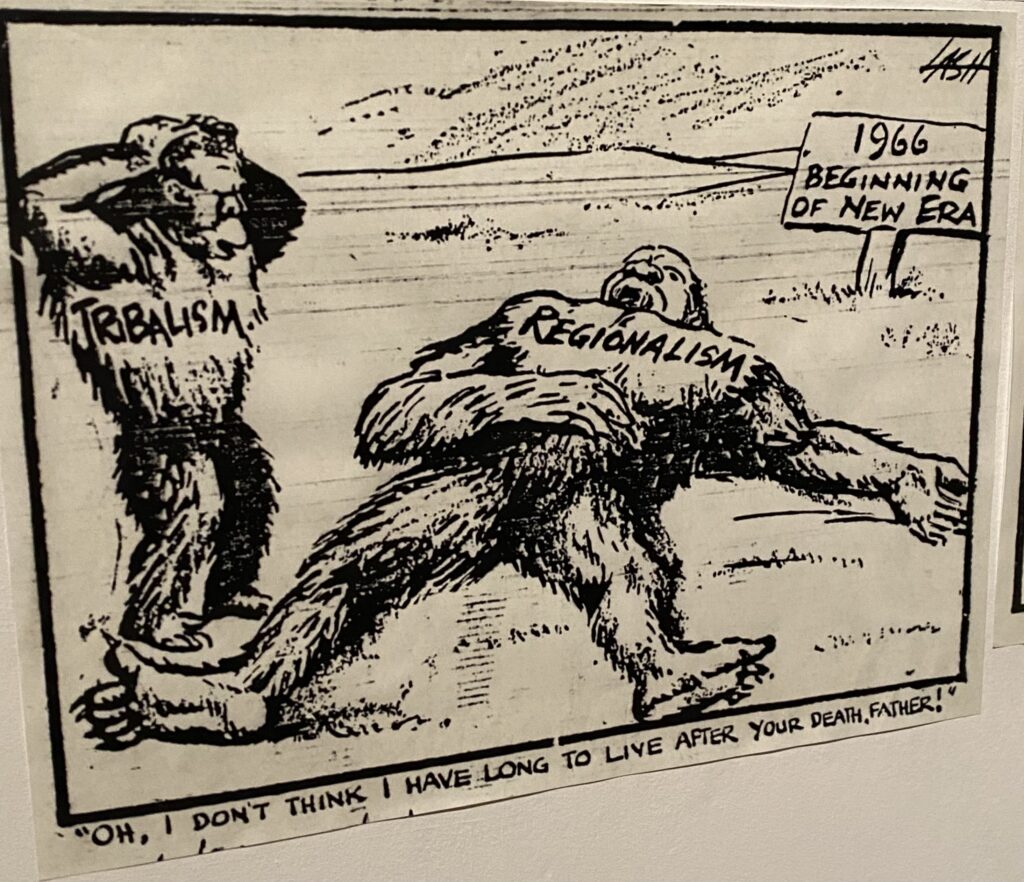
Laṣekan, a student of Onabolu, engaged with the grandeur of Nigerian history and myth through portraits of royal figures and mythical heroes. His portraits were of important social, cultural and political figures. Laṣekan is also acknowledged as the first cartoonist in Nigeria The cartoons were featured in the West African Pilot newspaper, which was launched in 1937 with Laṣekan signing his cartoons as “Lash”, and were a tool for his own activism and nationalist bent, to the political news stories featured in the paper.
Ben Enwonwu
Ben Enwonwu is probably one of the best known of the earlier Modernists, to us most notably because of the shape of his auction price index (623% increase off a 2003 base), indicating just how popular this artist is as a target for acquisitions in many collections and in acknowledgement of his being the first modern African artist to gain international recognition.
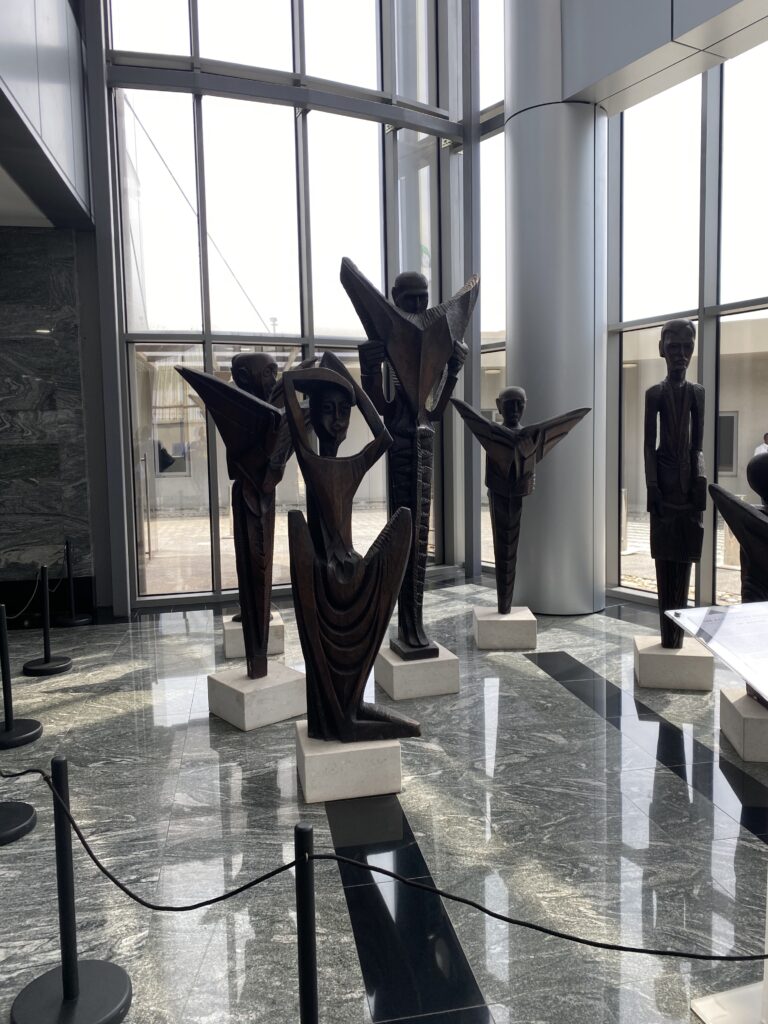
A notable work seen in the exhibition is the seven wooden sculptures, which were commissioned by the Daily Mirror in the early 1960s. They were subsequently acquired by Access Holdings plc and displayed at their head offices in Lagos. and seen when we attended in 2023 the launch of the book A King’s Passion: A 21st Century Patron of African Art, a chronicle of the art collection of the Obi of Onitsha, Igwe Nnaemeka Alfred Ugochukwu Achebe (Agbogidi).

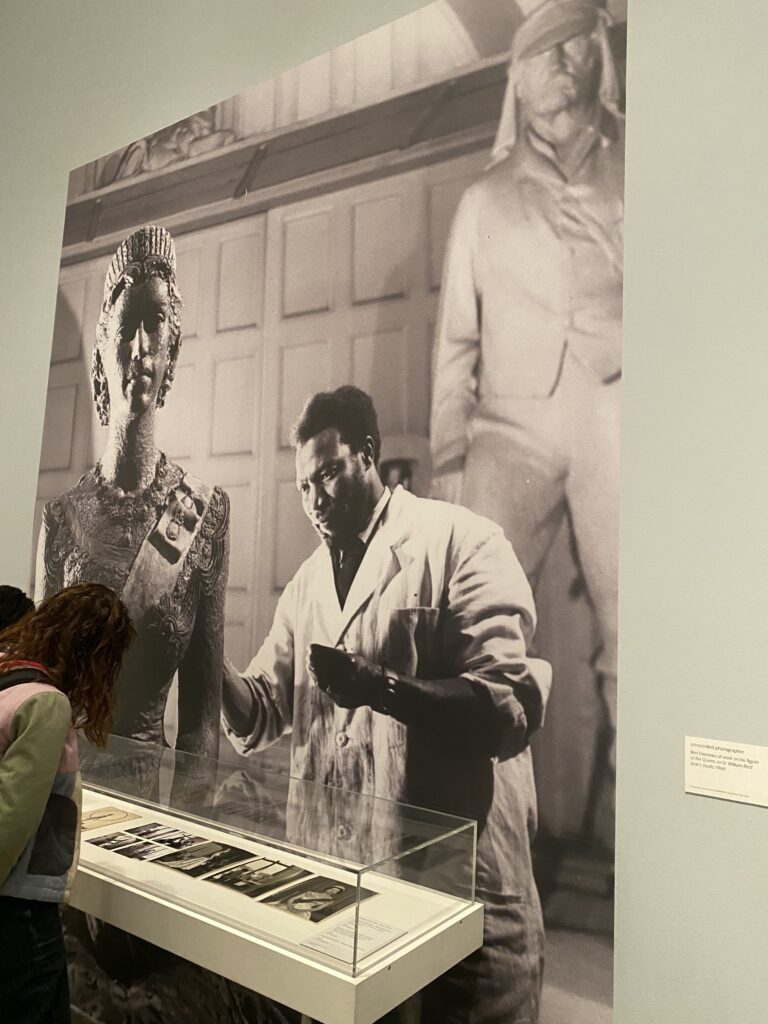
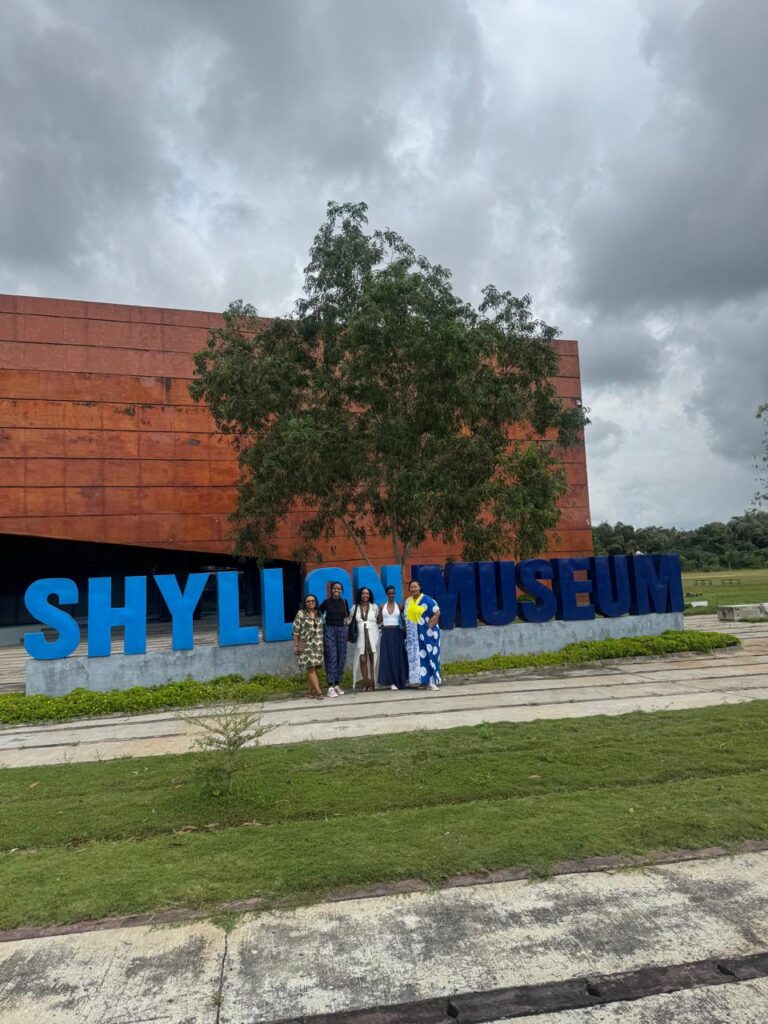
Having come across his instantly recognisable Anyanwu – The Rising Sun sculpture at Murtala Muhammed Airport (a wooden version), at the National Museum Onikan in Lagos, at the Yemisi Shyllon Museum of Art, as well as at a private collector’s home in Lagos, it was a surprise to see that the one in the exhibition was on loan from British King Charles III. That said, it should not have been a surprise since Ben Enwonwu lived in London for a period of time and was even commissioned in 1956 to create a bronze sculpture of British Queen Elizabeth II ahead of Nigeria’s independence from the UK. His African Dance series of paintings are also recognisable and a mainstay at auctions.
Ladi Kwali and Nigerian Modernism Beyond Painting
Ladi Kwali’s works featured in the exhibition are an important contribution that show that what might be known as craft can transition into the realm of fine art, and should so be recognised; Kwali’s contribution is even recognised as she features on the 20 Niara banknote.
Kwali learned pottery as a child through her aunt, using the traditional method of coiling. She made large pots for use as water jars, cooking pots, bowls, and flasks from coils of clay, beaten from the inside with a flat wooden paddle. They were decorated with incised geometric and stylised figurative patterns, including scorpions, lizards, crocodiles, chameleons, snakes, birds, and fish. “These decorations are an important aspect of the maker’s ethnic identity, alluding to folklore and storytelling drawn from motifs of body art and patterns used in architectural designs in Nigeria.
Her pots were noted for their beauty of form and decoration, and she was recognised regionally as a gifted and eminent potter. Kwali furthered her studies in Abuja, learning high-fired glazed stoneware. She exhibited in Britain, continental Europe and the US.
The Art Movements That Shaped Nigerian Modernism
Zaria Arts Society
Formed in 1958 by several artists at the Nigerian College of Arts, Science and Technology in Zaria, they called themselves the Arts Society and were labelled the Zaria Rebels by others. They sought to challenge the colonial curriculum, bringing the yearning for independence being achieved politically into their arts education. The society was led by Uche Okeke and comprised of Demas Nwoko, Bruce Onobrakpeya, Simon Okeke and Yusuf Grillo. “[Their methodology] posited fused inherited traditions like Igbo’s uli, Hausa geometries and Nok terracotta forms with the formal vocabularies of modernism. The praxis was one of reintegration and a reunion of the fragmented, the repressed, the spiritual and the ancestral into a syntax, rendered in contemporary form,” writes Aindrea Emelife, curator of Nigeria’s pavilion at the 60th Venice Biennale.
The Mbari Club
The club was a social and cultural hub formed in 1961 by German publisher and art collector Ulli Beier in partnership with several writers and artists, including those in the Zaria Arts Society. It was located in a former nightclub in Ibadan, a few hours’ drive north of Lagos, and was a space to conceptualise Nigeria’s modernism movements in the visual arts and literature spaces in the post-colonial era. The Club was named by famed author Chinua Achebe. The club hosted many solo shows by Nigerian and international artists, including those from Sudan, Japan, Germany and the Netherlands. Sadly, it closed in 1966, but had opened branches in Enugu and Osogbo.
The Oshogbo School
In 1963, Ulli Beier, with his second wife, British artist Georgina Beier, moved to Osogbo and set up studios and provided materials to young artists, including Twins Seven Seven, Muraina Oyelami, Jimoh Muraimoh, Asiru Olatunde, and Chief Nike Davis-Okundayo. Many of these artists’ works can also be seen at the JK Randle Centre for Yoruba Culture and History in Lagos.
The art movement emerged from a series of experimental workshops held by the Mbari Mbayo Club, which actively encouraged individual expression over rigid academic instruction. Chief Davis-Okundayo went on to create her own gallery, Nike Art Gallery, which is the largest gallery in Nigeria and possibly on the African continent, as it is said to hold some 25,000 pieces available for viewing and sale in Lagos.
The Nsukka School
A room in the exhibition was dedicated to the Nsukka School, a major Nigerian art movement and department developed in the early 1970s at the University of Nigeria, Nsukka, when Uche Okeke joined the department. Okeke encouraged students to develop new approaches to the uli motifs traditionally practised by women in Igbo culture. For Igbo women, uli was associated with ideas of beauty and morality.
The school includes former students and teachers who took the concepts and applied them to many other areas, such as social issues related to inequality and political life, and its association then extended beyond Igbo culture and to artists from other countries . Artists associated with the school include Obiora Udechekwu, El Anatsui, Tayo Adenaike and Ndidi Dike.
Artists Beyond Nigeria Who Influenced Nigerian Modernism
Two artists require a special call-out.
The first was Gerard Sekoto. As. with El Anatsui, one would be surprised to see the names of artists from other countries in an exhibition about Nigerian modernism. A painting by Gerard Sekoto was in the section covering Ben Enwonwu’s works and it turns out they had met at an African Artist roundtable in Rome in 1960. A discussion they had with Léopold Senghor on Africanité, the transatlantic Black literary and cultural movement of Negritude and globalism inspired a discussion with Uche Okeke and Clara Etso Ugbodaga-Ngu regarding the founding of a Nigerian Art Academy.
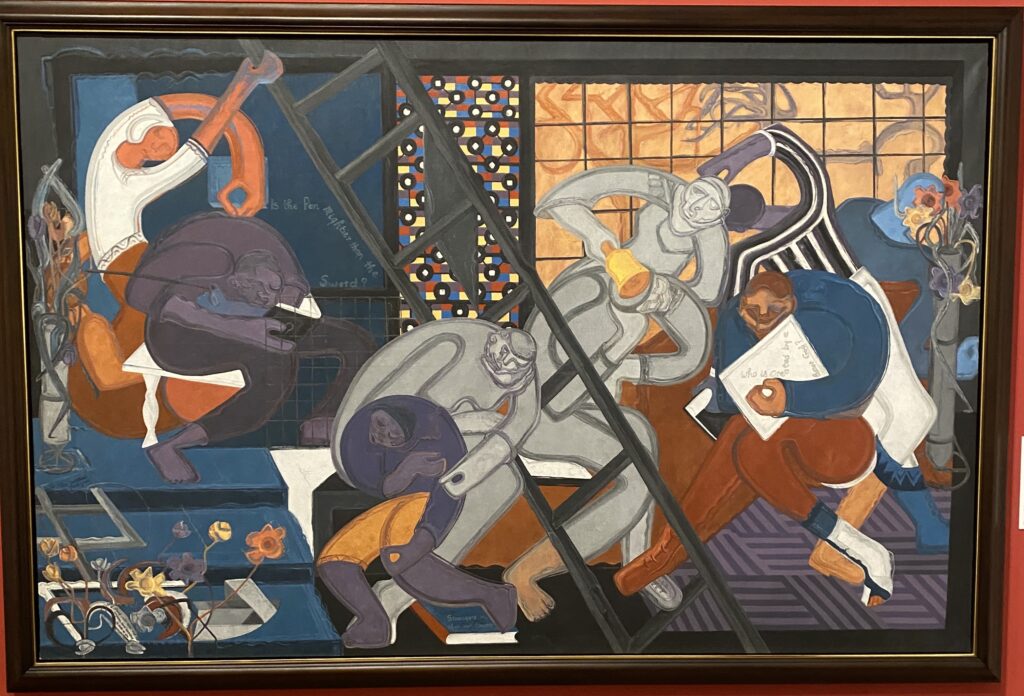
The second is William Uzo Egonu. While visually striking with many “Easter eggs” in the painting Will Knowledge Safeguard Freedom (1985), one struggled to place his works in the context of the rest of the show, but upon reading about his story, it made sense. Born in Onitsha, he showed early artistic talent and was sent to the UK in 1945 to realise his potential as an artist. He enrolled in the Camberwell School of Arts and Crafts, where he became interested in the techniques of High Renaissance and Flemish traditions. He applied to the Nigerian government for funding to continue his studies but was turned down.
Notwithstanding that setback, nationalist pride sustained Egonu and Nigerian themes and subjects were evident in his art and life throughout his time in the UK. He developed a fascination with printmaking although the technique meant he developed cataracts, and had to mix colours from memory. In 1989, Obiora Udechukwu described him as “perhaps the finest African painter” while Olu Oguibe wrote: “The forceful eloquence of the work is almost indescribable, as was the incredible simplicity of its language” – I couldn’t agree more.
Both Sekoto and Egonu had to navigate and carve out careers as African artists living and working in the diaspora of their home countries and yet also made an impact on Nigerian modernism and African art in general.
The Collectors
The genesis of the exhibition began with research into UK institutional collections of African art in 2022 and then evolved into a survey of the development of modern art in Nigeria. That said, many of the collectors from whom works were sourced were not UK institutions. Walking around the exhibition, the contributions of so many varying collectors shows not only the extent of the impact of Nigerian modernism worldwide but also how the curators integrated the works of many Nigerian collectors, many of whom we have been lucky to meet over the years.
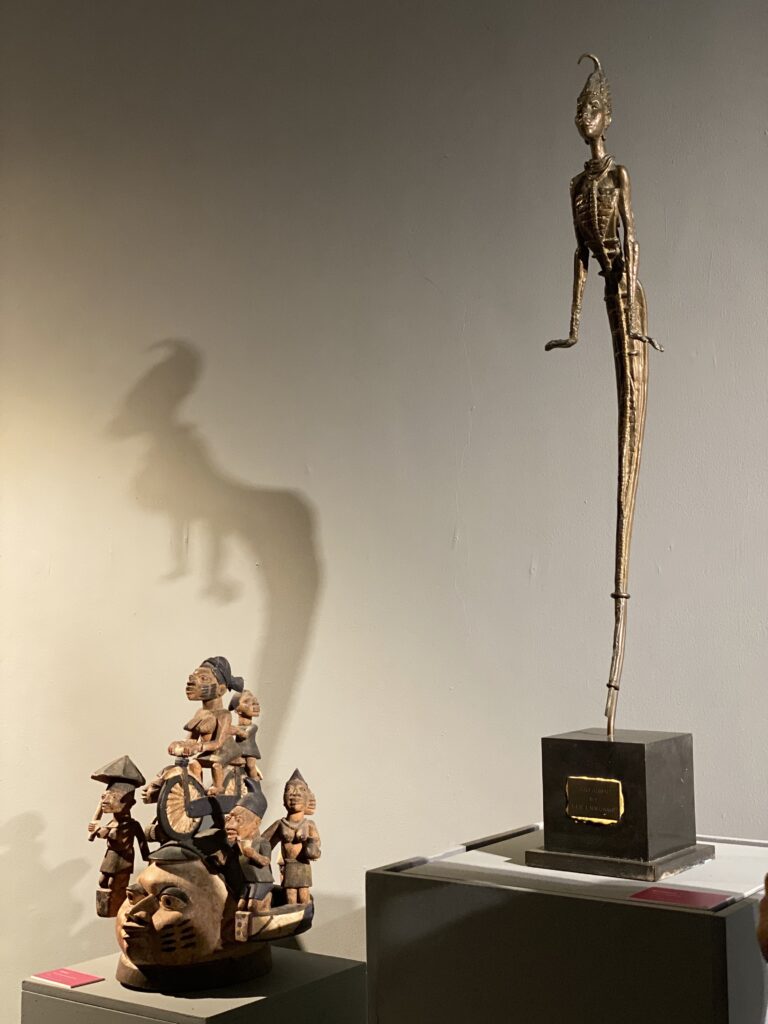
Seeing these works in their homes or in museums like the Yemisi Shyllon Museum of Art in Lagos and later in a storied institution like the Tate Modern speaks to the importance of art institutions in leveraging private collections to further academic research, in particular for countries and communities in the Global South. It is encouraging that this exhibition also collaborated with the Museum of West African Art in Benin City for the conservation of artworks which were to be included in the exhibition and which would return to Nigeria, an important sovereign cultural investment that will benefit Nigeria and the African continent at large.
We remain grateful for the generosity of many collectors who open their homes or open private museums to show their collections to other collectors and art enthusiasts, which also contributes to the sharing of knowledge about the artworks and artists for whom they have a passion.
Corporate Support and the Future of Modern and Contemporary African Art
Two Nigerian companies were the supporters of this exhibition. This underscores the importance of corporate entities in the support for the arts, and such exhibition support for major exhibitions. Be they for international institutional exhibitions or domestic ones, this should be a mainstay in more countries in the Global South, given the impact, as can already be seen from this exhibition.

Why Nigerian Modernism Continues to Matter Today
More than an exhibition, Nigerian Modernism: Art and Independence demonstrates how artists, collectors, institutions and patrons collectively shaped one of Africa’s most influential artistic movements. The exhibition also highlights how private collectors, museums and corporate supporters continue to preserve and expand the legacy of Nigerian Modernism for future generations.
All of this is to say, if you want to head to Lagos, Nigeria for a taste of the contemporary art which was formed from the foundations of modernism outlined in this phenomenal exhibition, join us from 3 to 8 November 2026.