

Lagos was a vibe! It always is. From the first time we went in 2022, it has captivated us. Art brought us, and we stayed for the culture. Once again, Capital Art collaborated with Soul Traveller Tours to host a curated trip during ART X Lagos 2025. We outline the highlights, the art we saw, the phenomenal people, and sights from our trip from 6 to 9 November 2025, across two blog posts.
ART X Lagos
ART X Lagos, started in 2016, was the first international art fair in West Africa. Tokini Peterside-Schwebig, a Nigerian businesswoman and art and culture activist, founded ART X Lagos. The art fair was launched to showcase and support the breadth of contemporary art from Africa and its diaspora.
The theme for the 10th edition of the art fair is “Imagining Otherwise, No Matter the Tide,” and it draws inspiration from Lagos and its dynamic history as a coastal city—celebrating the resilience and adaptability of communities, much like the mangrove roots that thrive regardless of changing tides.
15 galleries from four countries exhibited at the fair. What was really great about the exhibitions was the variety across mediums, sizes, and themes to capture the hearts (and wallets) of those attending the fair.
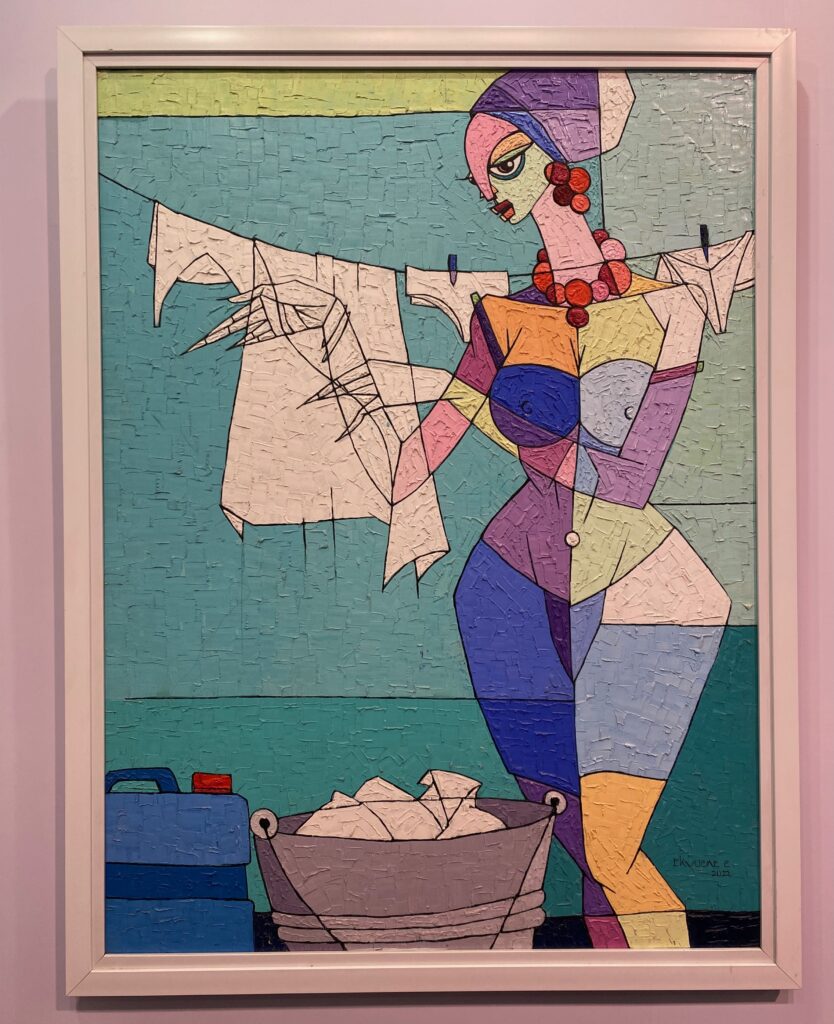
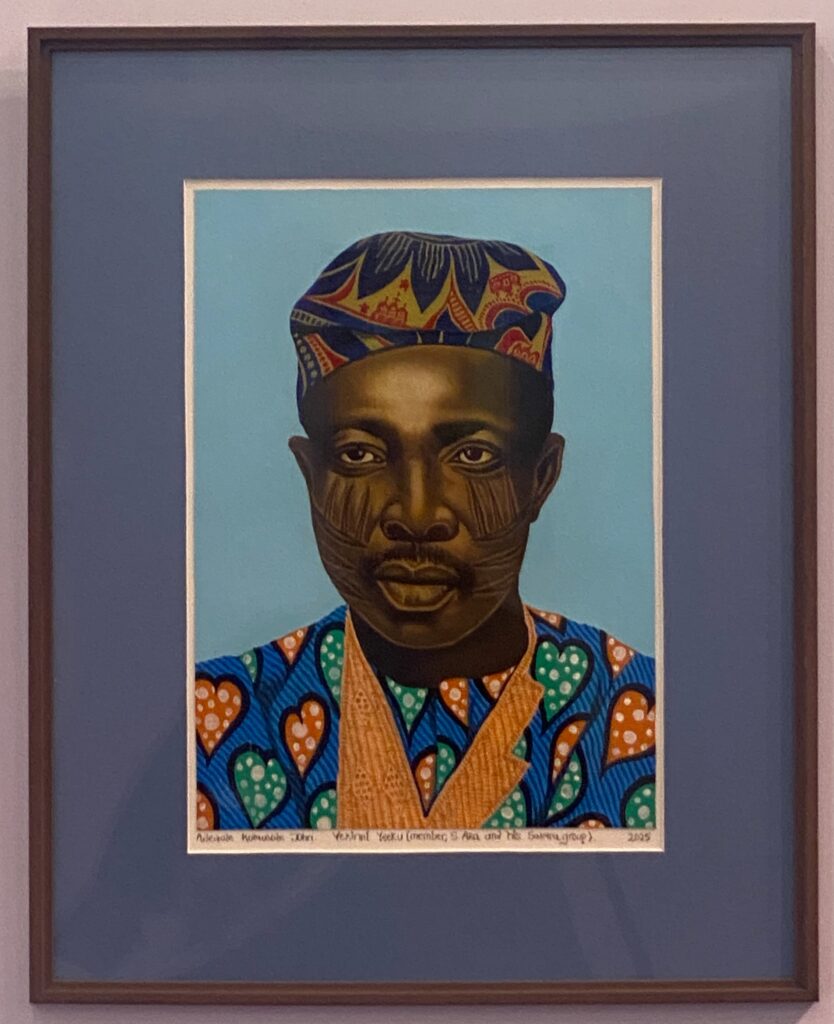
Right: Yekinni Yeeku (member, S.Aka and his Sakara group) (2025) by Adewale Kolawole John, as seen at Adegbola
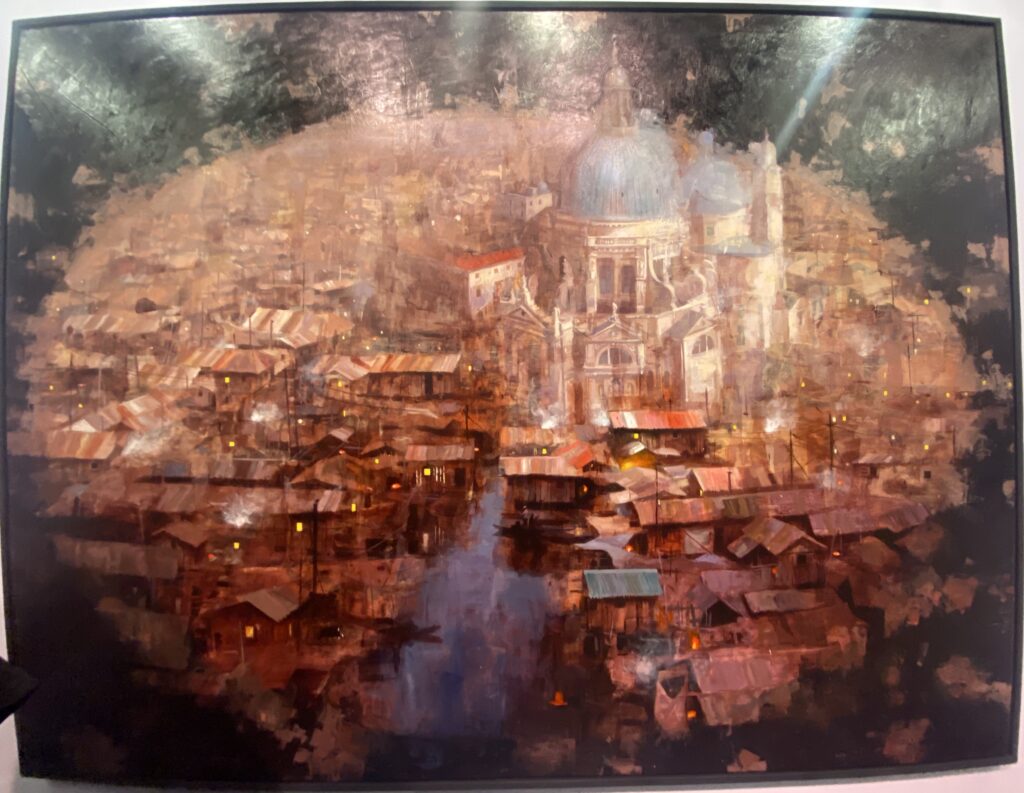
The fair also included eight other elements to the programming. Projects / special exhibitions and talks are a mainstay of many fairs, but ART X is unique. Their programme includes a concert and a cinema programme of several works created between 1959 and 2025.
Programmes, Projects and Events complement the main art fair
The Schools Programme went beyond having school children visit the fair. The programme included an exhibition of works by children from three schools, where they were tasked to reimagine Lagos. Another feature invited children to create prints inspired by the textures of the city, forming a collective mural of shared imagination.
A multitude of events now occur around the time of the fair. In addition to that, Lagos Art Week is now nestled in the broader culture calendar of Lagos, which includes fashion, design, film, and theatre spread over a period of approximately four to eight weeks.
A space for personal development as a collector
Additional exhibitions at ART X Lagos to spotlight are ART X ICON, a new platform to the ART X offering, and the fifth edition of Art Across Borders.
The inaugural ART X ICON exhibition, curated by Missla Libsekal and spotlighting J.D. Okhai Ojeikere (1930-2014), a Nigerian photographer. In the course of his work for the Nigerian Art Council, he began to take a series of photographs. This body of work, now consisting of thousands of images, has become a unique anthropological, ethnographic, and documentary national treasure. The Hairstyle series, for which he is most well-known, consists of close to a thousand photographs and is the largest and most thorough segment of Ojeikere’s archive.
The Art Across Borders exhibition was titled “we are where we think (we are)”. It explored decoloniality through regional artistic perspectives, centering Pan-African approaches to perception and location. Taking its title as both provocation and proposition, it embodied expressions of decoloniality across Africa and its diaspora. The features artists were
- Edson Chagas (Angola), Central Africa represented by Stevenson Gallery (South Africa),
- Mário Macilau (Mozambique), East Africa represented by Ed Cross Gallery,
- Nicène Kossentini (Tunisia), North Africa, represented by Selma Feriani Gallery (Tunisia),
- Fatoumata Diabaté (Mali), West Africa,
- Kudzanai Chiurai (Zimbabwe), Southern Africa represented by Goodman Gallery (South Africa), and
- Camille Chedda (Jamaica), Caribbean represented by The Olympia Gallery (Jamaica)
The Collector Preview was a great opportunity to see the works, have a catch-up with Lagos friends, and toast to 10 years of the ART X platform.
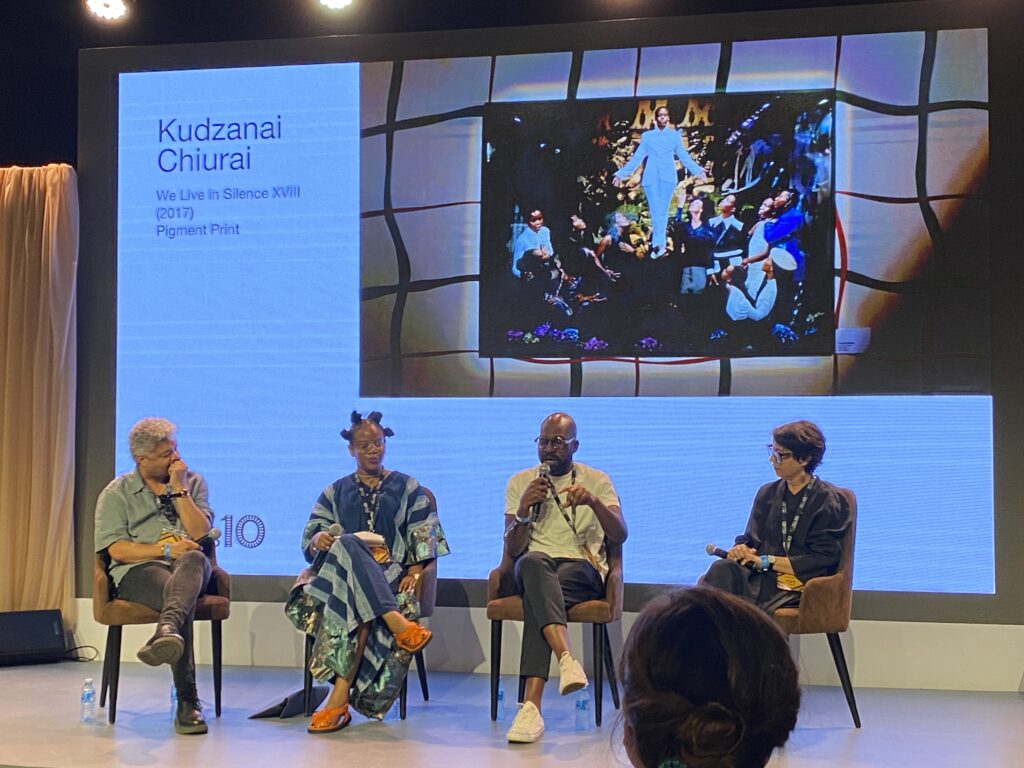
From L-R: Edson Chagas, Jumoke Sanwo, Kudzanai Chiurai and Nicène Kossentini.
Collector and Collection Visits during Lagos Art Week
Over the course of the four days, we had the privilege of visiting three collectors’ homes and seeing works from the collections of six collectors through the Collecting Now 2 exhibition at the Yemisi Shyllon Museum of Art.
Collector visits
Collector visits are an incredible opportunity to learn about artists, collecting practices, and to be inspired by fellow collectors. The collector home visits, in terms of artists collected, included works by modern and contemporary Nigerian artists such as Muraina Oyelami, Alimi Adewale, Uthman Wahaab, Yinka Shonibare, Deborah Segun, Abe Odedina, Ayobola Kekere-Ekun, Wura-Natasha Ogunji, and Babajide Olatunji. The collections also included an array of artists from other countries, such as Gerard Sekoto and Kehinde Wiley.
Works by the Olowo of Ise, one of whose sculptures was the inspiration for the design of the National Museum of African American History and Culture were another highlight. Seeing one of the largest collections of canonical artworks of Yoruba, Igbo, Urhobo, Cross River, Benin, and Benue River Valley origins resets how one sees art from one’s home country. Many of those works also featured in the book Making Histories, about the collection of one of the collectors.
Collecting Now 2
Following the success of the inaugural Collecting Now exhibition in 2024, the Yemisi Shyllon Museum of Art is showing a second edition. This year’s exhibition gathers together the visions of six distinguished collectors: Tayo Odunsi, Bimpe Nkontchou, Ify Momah, Yemi Ogunbiyi, Nonso Okpala, and Olufemi Akinsanya.
Curator Charles Udeh walked us through the exhibition and encouraged us to engage with the various topics the artworks prompted, such as Uthman Wahaab’s Victorian Lagos (2012) painting.
Reflecting a diversity of collection motivations
A few gems from the catalogue provide some insights into the contributing collectors:
- Odunsi privileges openness and originality, valuing works that resist reproduction in favor of interpretation, ensuring art functions as both a mirror and a catalyst for belonging.
- Nkontchou’s collection embodies advocacy and counter-narrative. Beginning in the 1990s as casual enjoyment, her practice matured into purposeful activism, supporting underrepresented voices, especially female and emerging artists.
- Momah’s collection redefines collecting as a form of artful living. Drawn to works that awaken or resonate emotionally, she privileges encounter over accumulation, transforming her home into a site of ongoing dialogue between artist and viewer.
- For Ogunbiyi, collecting is an act of guardianship; his collection preserves heritage across time, linking traditional forms with modern and contemporary expressions.
- For Okpala, collecting is a responsibility, not a possession, but as an act of amplifying voices and embedding African and Black art within global conversations.
- Akinsanya brings a distinctly Pan-African lens, weaving together modernist and contemporary works across geographies and generations. Akinsanya’s holdings reveal art as a stage where identity and history converge.
The Yemisi Shyllon Permanent Collection
Jess Castellote, director of the museum, joined us as we walked through works from the permanent collection. A few of the artworks were “missing” as they have been loaned to the Tate Modern, in London, United Kingdom, for the Nigerian Modernism exhibition. Highlights from the modernists were the wooden sculpture by El Anatsui and the meaningful family quilt by Chief Nike Okundaye–Davies. The sculpture by Peju Alatisse, a commentary on the practice of child marriages, and Uchay Joel Chima’s “Human Resources,” elicited moments of pause. The many objects of historical and cultural significance to Nigeria, such as the bronze works and others, were also educational for the group.
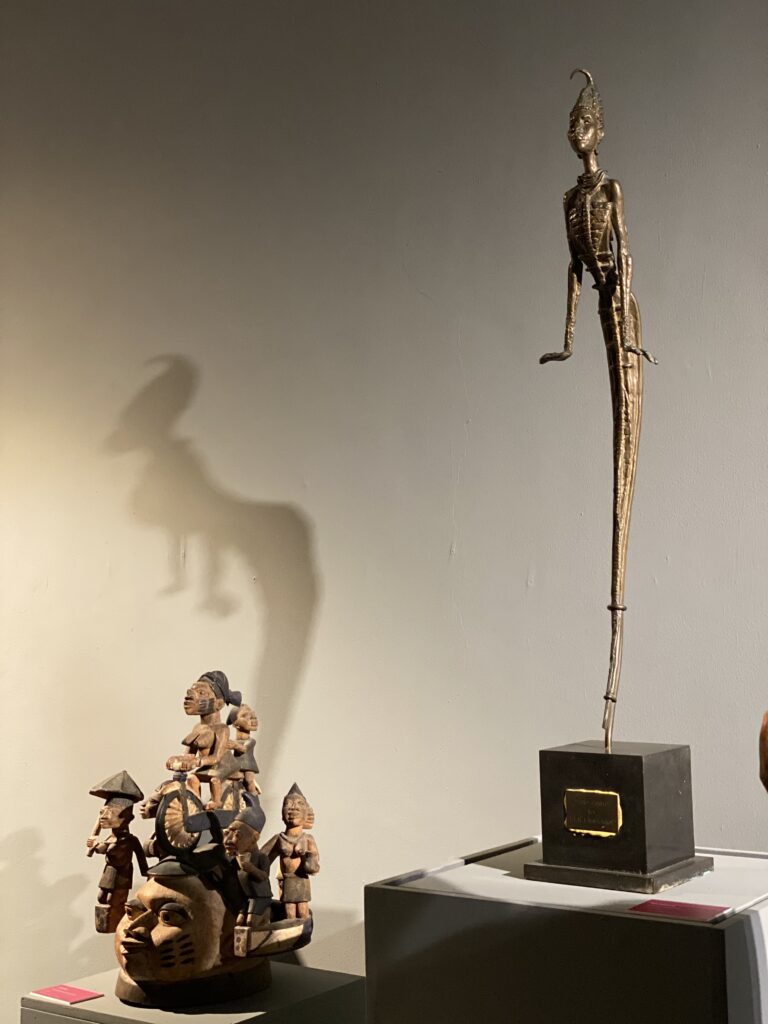
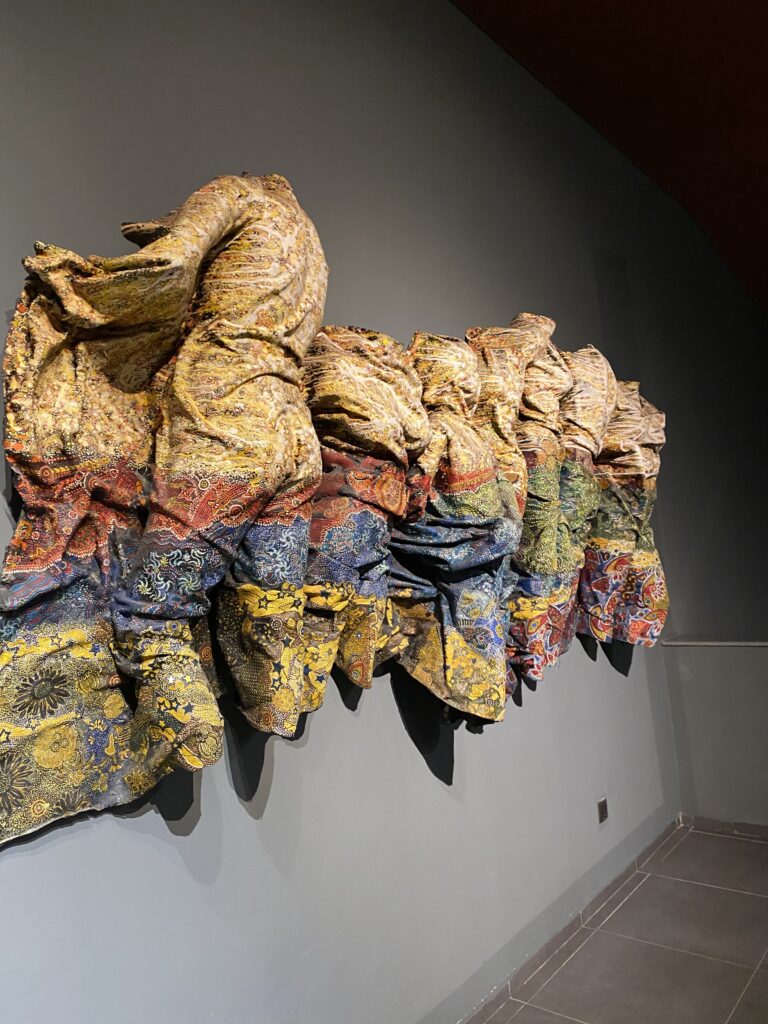
Yemi Ogunbiyi as part of the Collecting Now 2 exibition. on the left is a Gelede headdress while on the right is a bronze of Ben Enwonwu’s famous Anyanwu.
Right: Peju Alatise’s scultpure “Nine Year Old Bride” which is part of the permanent collection at the Yemisi Shyllon Museum of Art.
Gallery visit
The visit to Studio Ugoma for the show of Muraina Oyelami’s works was a great link to another modernist. Oyelami is one of Nigeria’s most influential modernist artists, renowned for his exceptional ability to create a rich visual diary that captures the landscapes, portraits, and emotions of everyday Nigerian life.
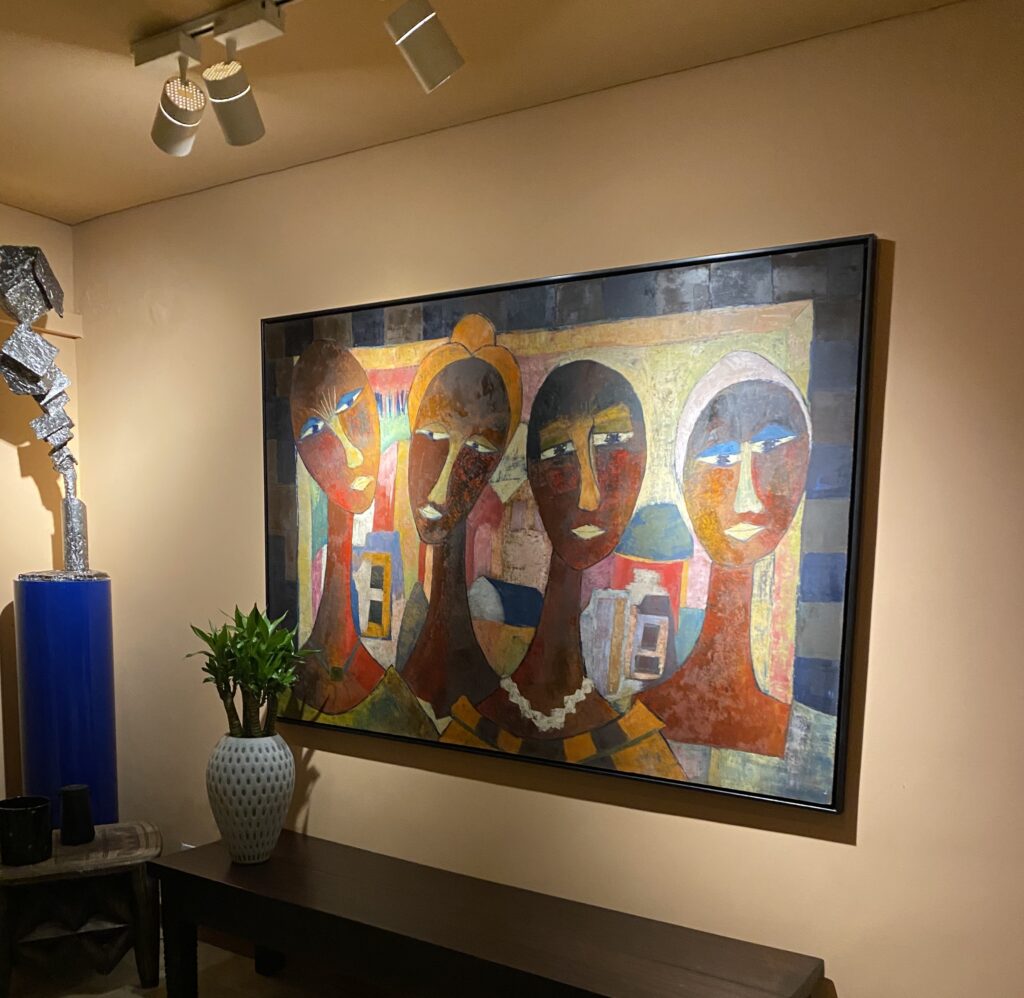
Oyelami has a distinct visual language, with the works seeming like they are pastel drawings. During the late 1960s and 1970s, Oyelami emerged as a central figure in the Oshogbo School of Art. He distinguished himself through a unique blend of traditional and modern elements. His contemporaries celebrated Yoruba culture, but Oyelami’s work stood out for its emotional depth and his attention to the nuances of daily life.
The Osogbo Art movement, or Osogbo School of Art, was a Nigerian art movement that emerged in the early 1960s in Osogbo, Osun State. It is known for blending Western media with traditional Yoruba aesthetics. Spearheaded by expatriates like Ulli Beier and Susanne Wenger, it developed through workshops at the Mbari Mbayo Club and fostered a generation of artists who drew inspiration from Yoruba mythology, culture, and modern life.
Works by Richardson Ovbiebo, Angela Isiuwe, Emmanuel Isiuwe, and others were also in the gallery. In one room we found an architectural model of Mbari Kola, which we were eager to visit the following day.
Lagos Art Week featured several more presentations by galleries – fortunately many of those exhibitions will continue well beyond the dates of the art fair.
Look out for Part 2 of the blog about the Lagos 2025 curated tour. You can receive notifications of its publication if you’ve signed up for our newsletter, or simply follow us on Instagram.