

Artists using technology in their practice is not controversial when one considers how art has evolved alongside technology. Photography changed what artists could capture and reproduce. Video introduced movement and time into the gallery. Printing helped scale access. Digital tools transformed image-making.
Today, artificial intelligence, augmented reality and robotics are opening up another set of possibilities, beyond NFTs which was the main topic considering art and technology just a few short years ago!
For collectors, this is more than an interesting development in artistic practice. Artists using technology in their practice are prompting us to reconsider what an artwork is, how it should be experienced and, importantly, what it means to own and preserve it.
Here are six examples that demonstrate just how varied the relationship between art and technology has become.
Why are artists using technology in their practice?
Technology is not necessarily replacing traditional artistic techniques. Instead, many artists are using it to extend what their practices can do.
Augmented reality can add another layer to a painting or sculpture. Artificial intelligence can become a tool, collaborator or subject. Robotics can introduce movement and interaction. Digital environments can allow artworks to exist beyond the gallery or one’s home.
For collectors, this creates an important distinction. Artists using technology in their practice may create works that are physical, digital or dependent on particular technologies to function.
That dependency introduces some important considerations for collectors. A painting can generally be conserved using established methods decades after it was created. Currently, a technology-based artwork may require software updates, specialist equipment, replacement components or migration to a new technological environment.
Either way, the use of technology is an exciting development and one to watch.
Digital art is increasingly relevant to collectors
This is no longer a niche area of collecting.
The 2025 Art Basel and UBS Survey of Global Collecting found that 51% of the 3,100 high-net-worth collectors surveyed had purchased a digital artwork in 2024 or 2025. Digital art accounted for an average 13% of their collections in 2025, compared with 3% in 2024.
For collectors, understanding artists using technology in their practice is therefore increasingly part of understanding contemporary collecting itself.
Paula Gaetano Adi: when robotics becomes sculpture
Argentinian artist Paula Gaetano Adi provides an intriguing example of how robotics can become part of artistic expression.
Her practice calls for a new technical imagination that radically attends to the world-making capacity of both technology and the arts. Rather than treating technology simply as a production tool, Gaetano Adi incorporates robotic systems into sculptural and performative experiences.
Her Guanaquerx (2024) is an example of this technologically engaged practice. It is a multi-day performance / expedition of a quadruped terrestrial robot named Guanaquerx,. The robot was accompanied by an army of artists, engineers, local muleteers, and 58 mules and horses. The performance aimed to promote an “andean cosmotechnics” for the libration of the planet, and enact an alternative technological revolution, 207 years after the Crossing of the Andes consolidated the liberation of South America.
A robot mimicing nuance and complexity of indigenous knowledge
A full-scale exploration rover Guanaquerx was modeled after the guanaco, the native mammal of the Andes, and inspired by the myth of the Yastay, the guanaco guardian of the mountains, son of Pachamama and brother of the wind. Constructed from caña colihue and dressed in Andean textiles, the robot fuses ancestral knowledge with contemporary robotic technologies. It is equipped with multiple payloads, including a multi-vision and sound sytem that records the soundings and images of the Andes and emits a synthetic relincho (whinny). Its mechatronic tail beats a traditional Andean drum, waves the flag of the Revolutionary Army of Artificial Liberation (ERLA), and on its chest, a metal plaque bears the Pluriversal Laws of Robotics, a radical rewrite of Asimov’s laws, pledging allegiance not just to humans, but to the earth and all its beings.
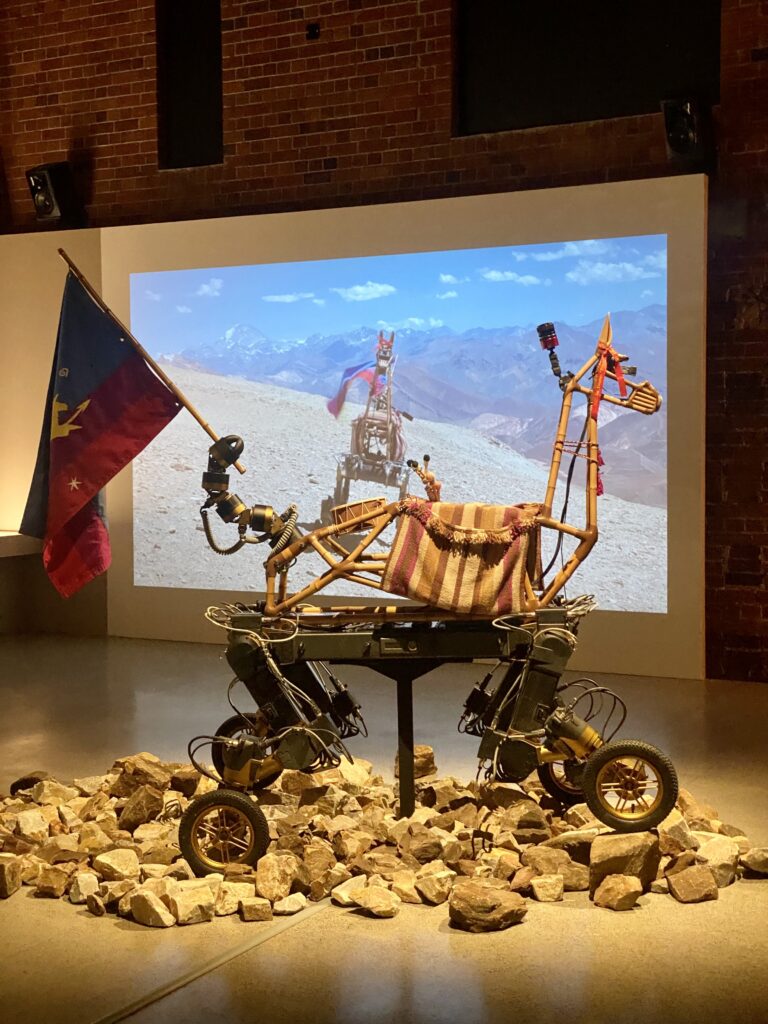
The work challenges the familiar idea that sculpture is fundamentally static. A robotic artwork can have movement, behaviour and conquer a feat such as cross the Andes, as part of its identity.
For collectors, this raises practical questions.
What happens if a motor fails? What happens if software becomes obsolete? Is the programming part of the artwork? Can components be replaced without compromising authenticity? It might also mean a work like this is impractical to collect, however it is a joy to experience. Guanaquerx (2024) can currently be seen at the Johannesburg Contemporary Art Foundation in the exhibition Reverse Futures until 5 December 2026.
National Gallery Singapore: augmented reality beyond the gallery
It is not only individual artists who are experimenting with technology. Museums and galleries are also using it to change how audiences encounter art.
The National Gallery Singapore’s Visions: An Outdoor Augmented Reality Art Exhibition explored augmented, virtual and mixed reality, allowing visitors to experience artworks through an augmented-reality platform.
The institution has also used Augmented Reality (AR) to bring art into Singapore’s public spaces. Its The People’s Gallery project transformed public housing “void decks” into temporary art spaces, with visitors able to access digital artworks using their smartphones.
These initiatives demonstrate how artists using technology in their practice can make artworks that are not confined to a traditional gallery or museum environment.
For collectors, this raises an interesting question: where does the artwork actually exist?
An AR artwork might depend on a particular building, landscape, public space, application or device. Its physical component may be only one part of the experience.
That makes documenting the work particularly important.
Augmented reality and new narratives
Fisherchild
Fisherchild is a community-based new media project which translates the oral storytelling archive of a small South African fishing community into an interactive digital repository of indigenous marine knowledge. The project builds on the ancestral and archival work of sixth-generation fisher child Traci Kwaai. Kwaai archives and retells the stories of the centuries-old community whose livelihoods are threatened due to lack of access to marine resources. As a child growing up under apartheid, Kwaai was denied access to the ocean spaces she lived across from.
The project was co-created by the artist duo Lo-Def Film Factory (Francois Knoetze & Amy Louise Wilson) and creative technologist Kyle Marais. Combining new media storytelling technologies like 360 video, photogrammetry, and Virtual Reality (VR) with traditional knowledge and practices, this project creates a repository for holding the stories of the Black and Brown communities of Kalk Bay, as well as a prototype for an archive of indigenous cultural knowledge. It aims to digitally preserve this community through the creation of a game-engine built experience. The experience consists of the 3D documentation of important artefacts, sites, and oral histories, as well as a site-specific audio walking tour.
This project is an important contribution to the growing field of African 3D digital cultural heritage.
Adilson de Oliveira: Another of the African artists using technology in their practice
South African artist Adilson de Oliveira is another compelling example of an artist working with augmented reality and extended reality. De Oliveira works across drawing, animation, printmaking, video and Extended Reality (XR), using technology to explore the relationship between physical and digital experiences. His earlier works have incorporated augmented reality, with viewers using the Artivive app to activate animated content.
He has also explored AR through the Magolide Collective. Some of their work includes QR codes embedded in clothing to activate digital animation through a smartphone.
His practice illustrates that technology can become part of a wider conversation about identity, history and cultural narratives rather than simply being a visual gimmick.
For collectors, both examples also demonstrate why a photograph of an artwork or an experience may not tell the whole story.
Drue Kataoka: AI as an artistic medium
Drue Kataoka’s practice demonstrates another dimension of technology and art: artificial intelligence (AI) as a creative medium. Drue’s works are rooted in Zen philosophy and span a breadth of material art forms including mirror-polished steel sculpture and painting, and technological art such as virtual reality, EEG (yes an artwork from measurements of brain activity measured using electrodes), NFTs, and art-science collaborations.
Drue Kataoka received the Women in GenAI Innovator Award for 2025 in recognition of her groundbreaking work as an artist and social innovator in artificial intelligence.
Her work raises questions that are increasingly relevant to collectors of AI-generated or AI-assisted art.
Who is the author of an AI artwork? What role did the artist play? Which AI tools or models were used? Is the work generated once, or does it evolve? What exactly constitutes the artwork—and therefore what exactly is being purchased?
These questions become particularly important when considering provenance and authenticity, and whether current art methodology is accounting for these varied nuances when it comes to technology or not.
For collectors of artists using technology in their practice, documenting the creative process and the model versions and associated documentation may therefore be as important as documenting the finished artwork.
Beeple and robotics at Art Basel Miami Beach
Perhaps one of the most spectacular recent examples of technology entering the art-fair environment came from Beeple at Art Basel Miami Beach in December 2025.
His Regular Animals installation formed part of Zero 10, Art Basel Miami Beach’s section dedicated to digital and new-media art.
The installation featured robotic dogs with hyper-realistic heads resembling figures including Elon Musk, Jeff Bezos and Mark Zuckerberg. The robots interacted with fairgoers, including taking photographs, with some images connected to NFTs.
The work brought together robotics, artificial intelligence, digital imagery, physical interaction and NFTs.
It also demonstrated the market appetite for technologically driven work. According to Art Basel, all ten works from Beeple Studios’ Regular Animals series sold during the VIP preview for US$100,000 each.
The example shows just how broad “digital art” has become. A technology-based artwork might be an image on a screen, an AI-generated work, an immersive environment—or a physical robotic installation.
What should collectors consider when buying works by artists using technology in their practice?
The excitement surrounding buying technology-based art should be accompanied by careful due diligence.
1. Understand what you are buying
Establish whether the artwork includes hardware, software, digital files, code, NFTs, applications or other technological components.
The sales agreement should clearly identify what forms part of the acquisition.
2. Document how the artwork works
For AR and interactive works, document exactly how the artwork is experienced.
Record the applications, software, hardware, devices and installation instructions required to activate it.
3. Consider technological obsolescence
Technology changes quickly.
Ask whether the artist or gallery has considered what happens when the original hardware or software is no longer supported.
Can components be replaced? Can software be migrated? Who is authorised to undertake repairs?
The objective is not necessarily to preserve every technological component forever, but to understand what changes can be made without compromising the artist’s intentions.
4. Keep the documentation
Certificates of authenticity, invoices and provenance records remain important—but technology-based works may require additional documentation.
Collectors should consider keeping installation photographs, technical specifications, software versions, manuals, passwords or access information where appropriate, and correspondence with the artist or gallery.
This information can become invaluable years later.
5. Think about provenance and future value
The history of a technology-based artwork may include more than its previous owners and exhibitions. It could also include upgrades, migrations, repairs and changes to technological components.
This makes good collection management particularly important.
Capital Art’s approach to art collection management helps collectors professionally organise information about their artworks, including the documentation that supports their collections.
The future of collecting may be increasingly technological
The examples of Paula Gaetano Adi, the National Gallery Singapore, Fisherchild and Adilson de Oliveira, Drue Kataoka and Beeple demonstrate that there is no single category called “technology art”.
Technology is becoming embedded across artistic practices. It can animate sculpture, extend painting into augmented reality, generate imagery, create immersive worlds, introduce robotics or connect physical artworks with digital assets.
For collectors, this creates exciting opportunities—but also a responsibility to think differently about collection management.
When acquiring a technologically enabled artwork, the object itself may be only part of the story. The software, instructions, digital files, hardware and artist’s intentions may all contribute to preserving the work.
As artists using technology in their practice continue to push the boundaries of what an artwork can be, collectors who understand both the artistic and technological dimensions of these works will be better equipped to collect, preserve and enjoy them for years to come.
Technology may change quickly. A well-documented collection should not have to.