
As an economic ecosystem, the art market is often understood through the lens of scarcity economics: an artist’s death caps supply, with the rarity of work acting as a driver of value.
Yet scarcity alone is an insufficient driver. Many enduring blue-chip names—think Warhol and Picasso—are anchored not so much in scarcity as they are in liquidity and consistent institutional validation. Collectors and investors who rely solely on scarcity as a signal risk exposure to thin, shock-prone markets.
Rather, true resilience in the market for an artist’s work arises from some combination of three elements. First is the scarcity premium, a premium derived from controlled, finite supply. Second is layered liquidity, meaning a stratified market with depth across multiple price bands. And the third piece is institutional endorsement, where museums, curators, and critics can act as stabilizing agents—a kind of cultural central bank.
Scarcity: one of the key drivers of art markets that is the most intuitive
Jean-Michel Basquiat (1960–1988) exemplifies the effect of the scarcity premium. His premature death at 27 capped his output at some 600 paintings and 1,500 works on paper. Each major work that enters a permanent collection—whether MoMA, the Brooklyn Museum, or the Centre Pompidou—concentrates demand on a thinner market.

This scarcity, reinforced by curatorial interest, has propelled prices for Basquiats into nine-figure territory. Sotheby’s 2017 sale of his Untitled (1982) at $110.5 million, among the most expensive paintings ever sold, is the archetype: finite supply, combined with institutional validation, transforms illiquidity from liability to strength.
Scarcity is, however, by no means a guarantee of value. Amedeo Modigliani (1884–1920) and Egon Schiele (1890–1918), despite dying young with truncated outputs, did not command sustained premiums until critical reassessments decades later. Absent institutional validation, the “policy rate” of cultural legitimacy, scarcity risks degenerating into dead capital, as works without museum endorsement or critical recognition may fail to sustain liquidity or market relevance.
Prolific outputs create stratification
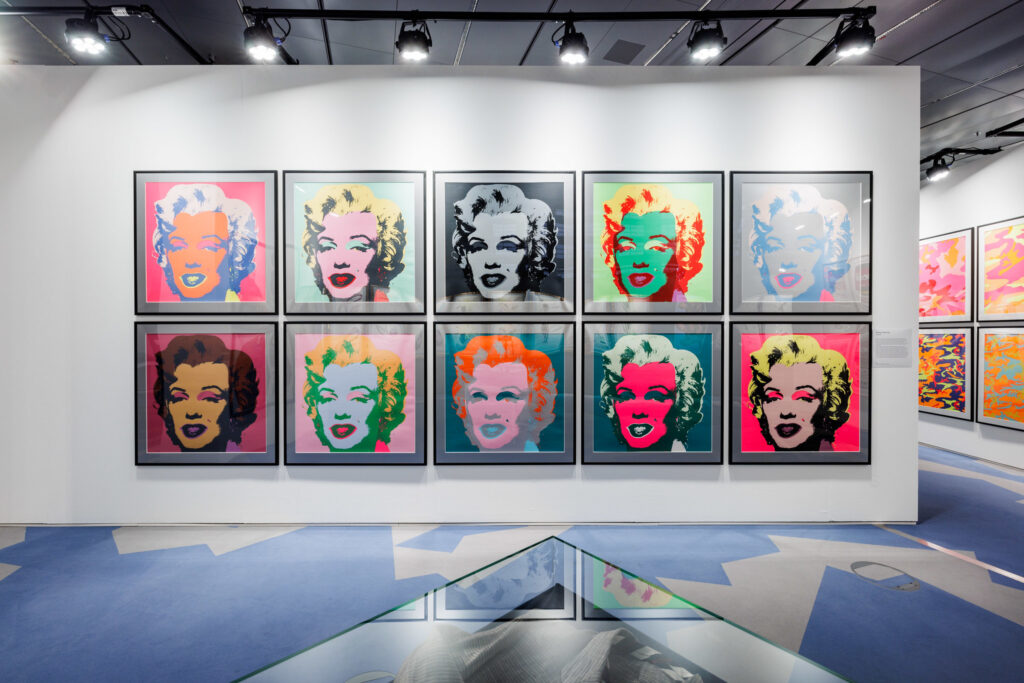
Andy Warhol offers a counterpoint. His prolific, industrial-scale production created tens of thousands of works across paintings, screenprints, and multiples. In theory, such abundance should dilute value, but Warhol’s market is stratified into tiers: accessible entry points, such as US$50,000 prints; mid-market paintings in the low millions; and a trophy layer where marquee works like Shot Sage Blue Marilyn (1964) reached US$195 million at Christie’s in 2022.
This layered liquidity—the presence of multiple entry points across price bands—ensures broad participation, market depth, and resilience. In this sense, Warhol’s market finds a theoretical parallel in the index fund: wide accessibility at the base, with scarcity concentrated in the upper echelons. By contrast, Basquiat’s market resembles that for a thinly traded commodity: scarcity is intense, but market participation is narrow.
Stratification in markets for living artists
Certain contemporary markets similarly demonstrate a tiered structure with relative accessibility at the base and scarcity concentrated at the top, even within a single medium. The Ghanaian painter Amoako Boafo’s (born 1984) works illustrate this clearly: smaller portraits have sold in the mid-six-figure range (USD), while the iconic Hands Up (2018) sold for a record-breaking $3.42M at Christie’s Hong Kong in 2021.

The Brazilian artist Beatriz Milhazes’s (born 1960) abstractions show a similarly layered market, ranging from screenprints in the US$20–30K range to a canvas that reached nearly US$2.1M Sotheby’s New York in 2019. These price ladders can both attract a broad collector base and preserve elite scarcity at the uppermost tiers, creating resilience across market cycles. In this sense, the scarcity–layered liquidity framework provides a useful lens for understanding art market behavior more broadly.
Takeaways for collectors
Leverage one of the key drivers of art markets: In art, illiquidity can function as a strategic asset.
Unlike in venture capital, where lock-ups are a cost of entry, illiquidity in the art market often enhances value by signaling rarity and prestige. The key is to consider that in the absence of layered liquidity—accessible entry points across price tiers—or institutional support from major collections, scarcity risks collapsing into irrelevance.
Institutions still hold sway.
Institutional endorsement can function as a stabilizing “policy rate,” signaling legitimacy to the collector base and anchoring scarcity premiums. Acquisition patterns and landmark exhibitions can influence price expectations and collector behavior as decisively as macroeconomic signals influence financial markets. Savvy collectors monitor these institutional movements alongside auction calendars to anticipate shifts in demand.
Prioritize layered liquidity.
Markets with stratified participation, such as Warhol’s, provide multiple entry and exit points, mitigating exposure to volatility while sustaining broad market confidence. Layered liquidity ensures that the market can absorb shocks without eroding top-tier valuations.
Construct balanced portfolios.
Optimal strategy blends high-scarcity, trophy-level assets with holdings in markets characterized by layered liquidity. Basquiat-like scarcity can deliver potential outsized appreciation, while assets like Warhol and Picasso can provide stronger structural resilience.
As key drivers of art markets, scarcity, layered liquidity, and institutional endorsement therefore provide useful lenses through which to assess art markets. Collectors who strategically integrate these dimensions into their practice position themselves to achieve compounded, durable value over time, translating cultural capital into sustained financial advantage.
Guest contributor Weili Jin studies economics and art history at Stanford University.